But does it matter?
I don’t usually say that sort of thing here. I try to be more measured, less personal.
I’m talking about the police face recognition1 vans obviously.
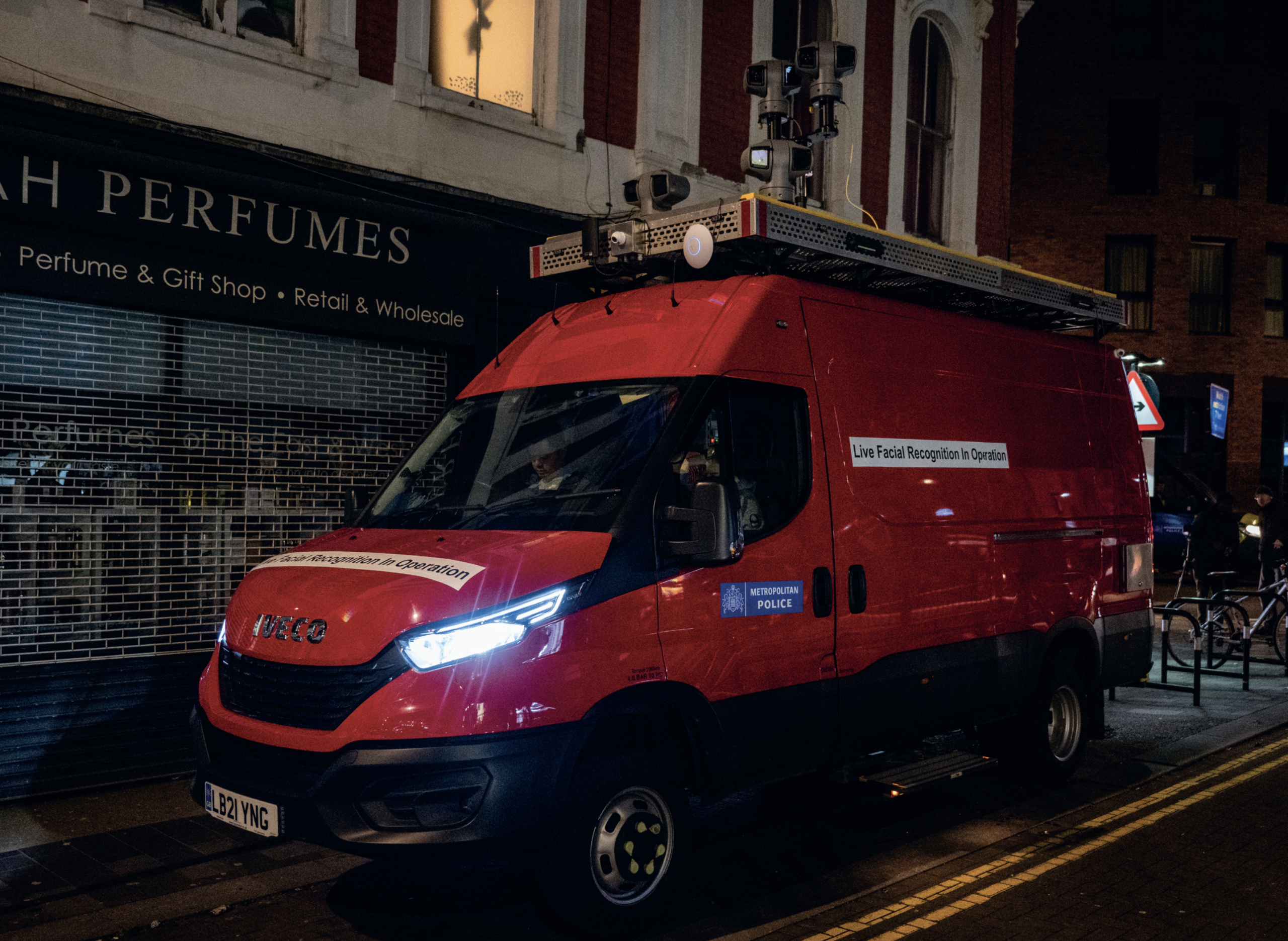
This might not surprise you: I mean that I don’t like them. I’m an old git after all, a man who’s written here before about the erosion of elementary freedoms, commodification, dehumanisation. The cameras make me uncomfortable and unhappy (and I haven’t even met one yet). I think they do damage to the public realm, chip away at our autonomy and subjectivity and diminish us as human beings. They’re a really bad thing.
At the moment these things have to be driven up and parked somewhere prominent, surrounded by coppers giving out leaflets, but the technology will, we already know, soon be passively present almost everywhere. In body-worn cameras, doorbell cameras, dashcams and High Street surveillance systems. Every camera everywhere will be a face recognition camera.
So it won’t matter that I don’t like any of this: a room full of civilian police employees identifying me and reviewing my behaviour before I can go shopping. Patronising plod pointing his Orwellian gadget at me while I walk between McDonalds and B&M – “don’t worry, sir, we delete your data almost immediately.” Security guards and business owners turning me over to the police for identification (or using their own, private systems).
I am gratified to learn that UK law – for the time being – allows me to cover my face when I’m in shot or to take a detour to avoid a camera2 – and I’ll do so, but in the full knowledge that there’ll soon be no point because they’ll be everywhere and, anyway, they’ll also recognise other aspects of my appearance that are harder to disguise, including, for instance, my gait or my body shape.
And the reason I ask ‘does it matter?’ is that I can’t be alone. I can’t possibly be the only grumpy old git who thinks these things reduce us to an observed mass, strip us of our subjectivity, rendering us objects of study – zoo animals, beings under suspicion. Waiting for our analysis, our diagnosis, our verdict3.
Some proportion of the affected population – which will be all of us, of course – is going to be permanently uneasy while out in a public place, circulating in a shopping mall or a concert venue or a public park or a school or a doctors surgery. Under close observation, a bit like the badgers on Springwatch or those recognisably human patches of pixels lit up in a shot from a surveillance drone or a satellite.
And, to state the obvious, it doesn’t matter. It doesn’t matter how many people object4 to this new infrastructure, how many individual human beings are going to hate being stitched into this increasingly malign fabric of scrutiny and reduced to nodes in a grid, haunted by observation: diminished, denatured and dehumanised. It doesn’t matter at all.
- Do you know why they say ‘facial recognition’ and not ‘face recognition’? I’m convinced this isn’t just a dumb grammatical error. I think it’s a dark, obscurantist trick – meant to disguise the actual intent of the systems. ‘Facial’ is a fancy term, one remove from the perfectly good noun they’re avoiding. I think it’s meant to slightly diminish our discomfort: “they’re not recognising my face, they’re just doing something facial.” ↩︎
- And don’t be feeling too smug about this – if an officer thinks you’re trying to disguise your appearance, you can be forced to comply anyway. ↩︎
- It’s very hard to imagine that this new infrastructure won’t pretty soon be integrated with the rest of the machinery of observation – digital ID, social credit, benefits, health data and so on. ↩︎
- This data from the UK government suggests that about 9% of the UK population objects to the use of face recognition by the police. ↩︎
Leave a Reply