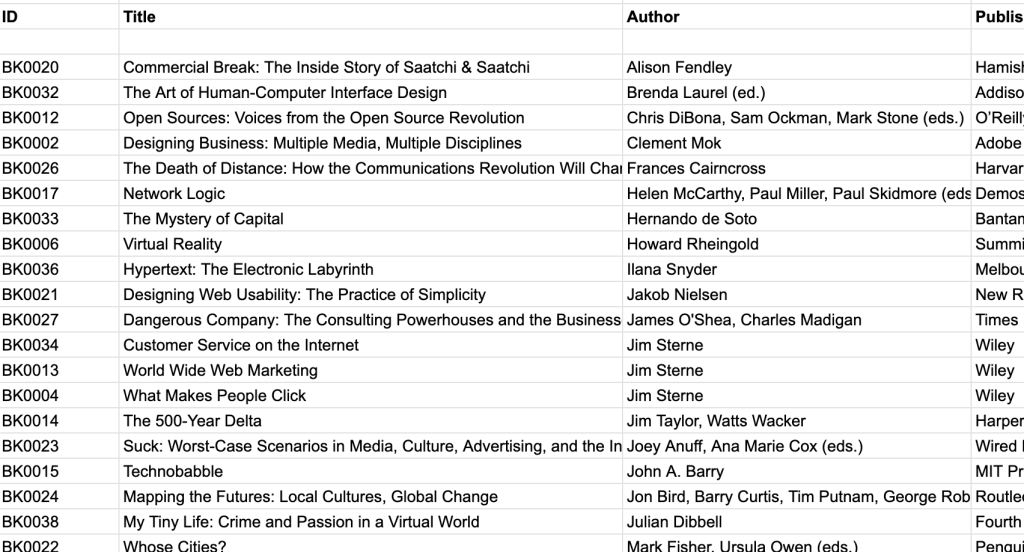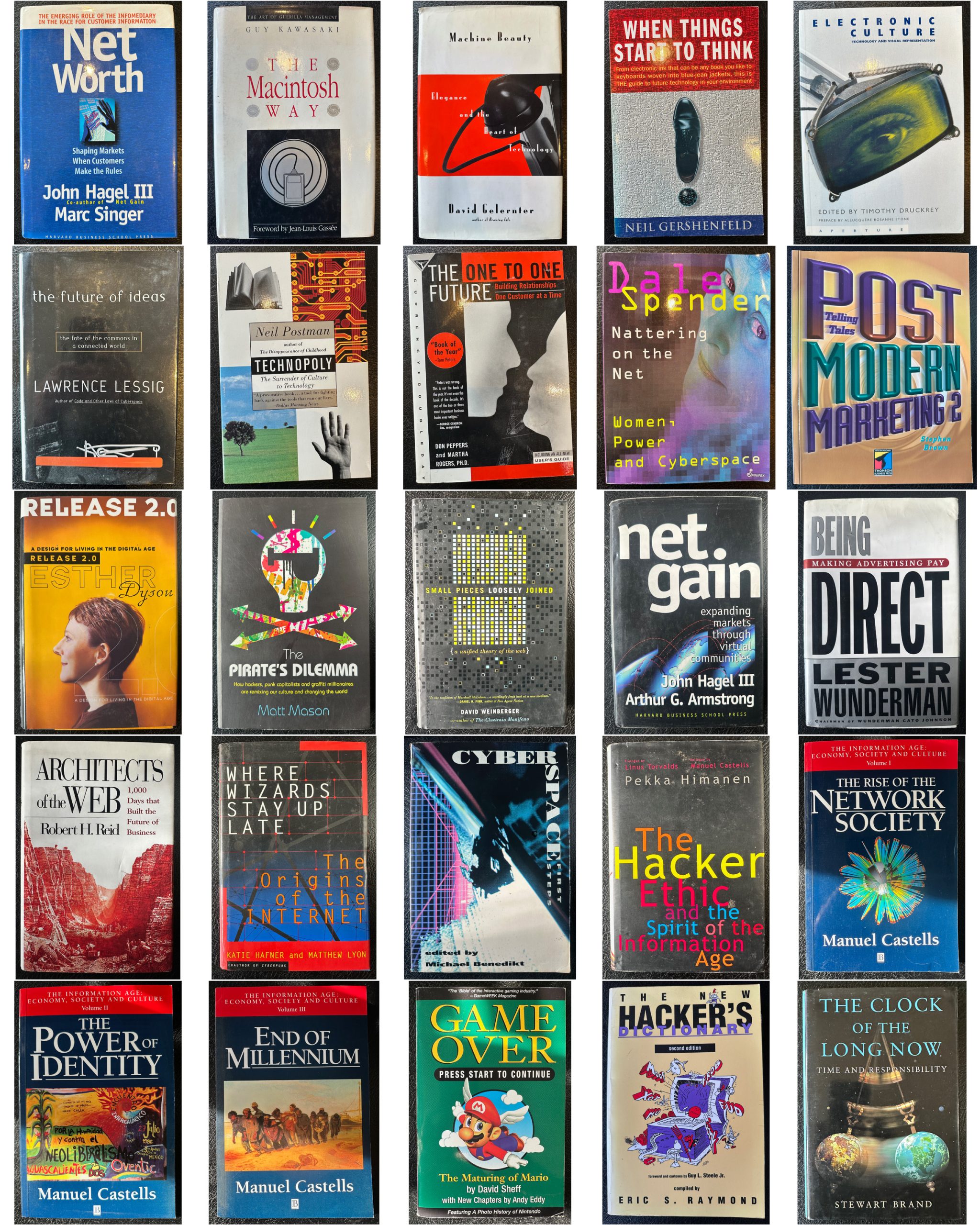
Over 100 books from the dot-com era looking for an appreciative home
I started buying books about the internet in the mid-1980s, long before I’d actually encountered it. I was studying photography, but I was obsessed with the net (largely because I’d read Neuromancer obvs). My undergraduate dissertation was a detailed disquisition on the impact of a computer network that hadn’t actually arrived yet on our image world: a strange, distributed, apparently ungovernable thing that seemed to me likely to change everything. A couple of those early books survive into what became, over the following two decades, a fairly substantial working library of the cyber-utopian moment.
History tells us this obsession led, in 1993, to a fateful collision with a bloke called Ivan Pope, who had developed a similar obsession while at art school. We started a web design firm called Webmedia, one of the first. There were more businesses, adventures in venture capital, a crash, then – kind of definitively for me at least – the big crash.
The books kept accumulating: becoming, I guess, the intellectual furniture of a moment we were living inside, bought and read in real time, as we built the thing, and they followed me around, from business to business and from office to office and now they’re in my study and we’re going to be moving to a smaller house so I’m trying to take a grown-up, unsentimental approach to downsizing this mountain of stuff.
The collection runs from the late 1980s to 2008 or so — from the first stirrings of the consumer internet through to the point at which Web 2.0 had begun to solidify into something recognisably like what we have now (and are only lately, and rather too slowly, becoming sceptical of). There are – I just counted – 106 volumes: business futurism, hacker culture, interface design, digital economics, open source philosophy, e-commerce theory, critical responses to the information age (some enormously influential texts, some prescient business books, a small sampling of absolute bollocks that I hope now fully embarrasses the authors). The complete Manuel Castells Information Age trilogy. Rheingold’s Virtual Reality. Cyberspace: First Steps. The Cluetrain Manifesto (first edition). Mondo 2000 User’s Guide to the New Edge. Kevin Kelly. Negroponte. Don Tapscott. Richard Florida. Diane Coyle. Donna Haraway. Dale Spender. The Readme! Filtered by Nettime, which almost nobody has heard of and which is a genuine artefact of that strange, briefly optimistic moment.
These are the books we were reading when we thought we knew where it was all going. They are, in other words, almost perfectly calibrated documents of a particular and historically significant wrongness — which is perhaps why Edinburgh University Library, which is building something it calls a ‘library of mistakes’, recently bought a dozen of them.
I’d like to sell the remainder as a collection rather than individually, but I’ll consider breaking them up if you’d like a fairly substantial chunk. If you’re a librarian, an academic institution, a researcher, or someone building an archive of the period, I’d be glad to hear from you. The full list is here. I’m in the outer suburbs of North London and can ship anywhere. They’re all in good nick and I can send you pictures of front covers and title pages if that would be useful.