A dot-com cyber-futurist library

Over 100 books from the dot-com era looking for an appreciative home

I started buying books about the internet in the mid-1980s, long before I’d actually encountered it. I was studying photography, but I was obsessed with the net (largely because I’d read Neuromancer obvs). My undergraduate dissertation was a detailed disquisition on the impact of a computer network that hadn’t actually arrived yet on our image world: a strange, distributed, apparently ungovernable thing that seemed to me likely to change everything. A couple of those early books survive into what became, over the following two decades, a fairly substantial working library of the cyber-utopian moment.

History tells us this obsession led, in 1993, to a fateful collision with a bloke called Ivan Pope, who had developed a similar obsession while at art school. We started a web design firm called Webmedia, one of the first. There were more businesses, adventures in venture capital, a crash, then – kind of definitively for me at least – the big crash.

The books kept accumulating: becoming, I guess, the intellectual furniture of a moment we were living inside, bought and read in real time, as we built the thing, and they followed me around, from business to business and from office to office and now they’re in my study and we’re going to be moving to a smaller house so I’m trying to take a grown-up, unsentimental approach to downsizing this mountain of stuff.

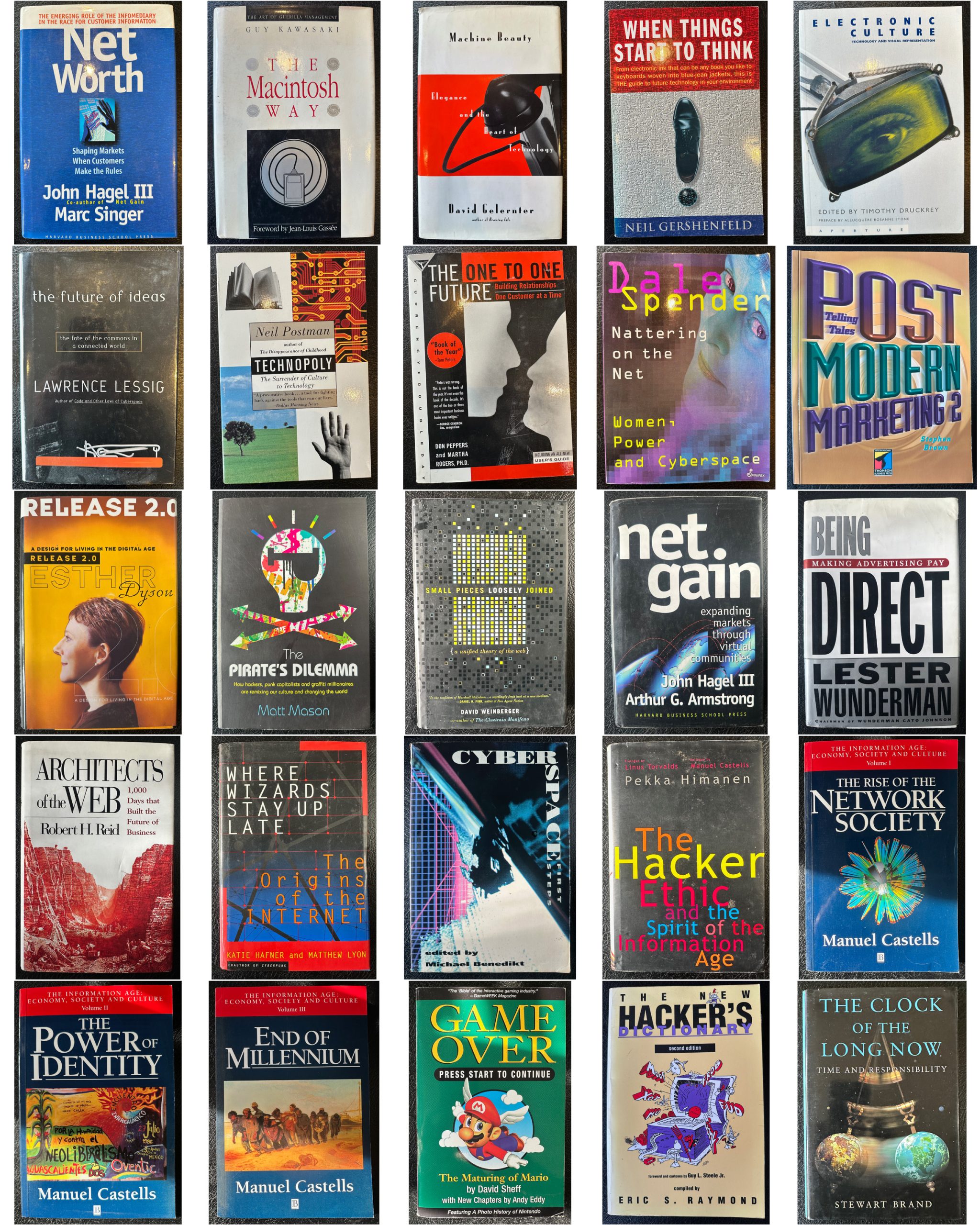
The collection runs from the late 1980s to 2008 or so — from the first stirrings of the consumer internet through to the point at which Web 2.0 had begun to solidify into something recognisably like what we have now (and are only lately, and rather too slowly, becoming sceptical of). There are – I just counted – 106 volumes: business futurism, hacker culture, interface design, digital economics, open source philosophy, e-commerce theory, critical responses to the information age (some enormously influential texts, some prescient business books, a small sampling of absolute bollocks that I hope now fully embarrasses the authors). The complete Manuel Castells Information Age trilogy. Rheingold’s Virtual Reality. Cyberspace: First Steps. The Cluetrain Manifesto (first edition). Mondo 2000 User’s Guide to the New Edge. Kevin Kelly. Negroponte. Don Tapscott. Richard Florida. Diane Coyle. Donna Haraway. Dale Spender. The Readme! Filtered by Nettime, which almost nobody has heard of and which is a genuine artefact of that strange, briefly optimistic moment.

These are the books we were reading when we thought we knew where it was all going. They are, in other words, almost perfectly calibrated documents of a particular and historically significant wrongness — which is perhaps why Edinburgh University Library, which is building something it calls a ‘library of mistakes’, recently bought a dozen of them.

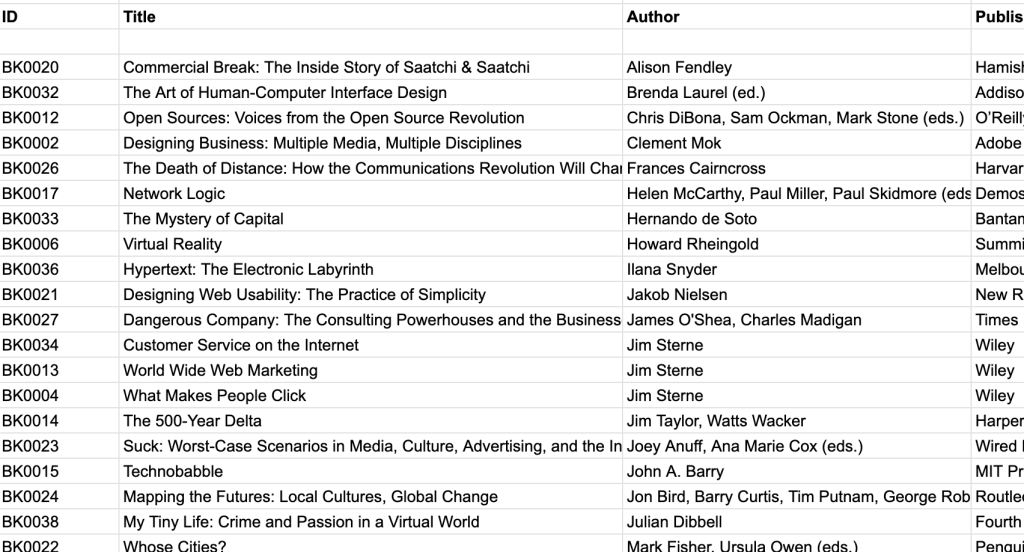
I’d like to sell the remainder as a collection rather than individually, but I’ll consider breaking them up if you’d like a fairly substantial chunk. If you’re a librarian, an academic institution, a researcher, or someone building an archive of the period, I’d be glad to hear from you. The full list is here. I’m in the outer suburbs of North London and can ship anywhere. They’re all in good nick and I can send you pictures of front covers and title pages if that would be useful.
You know, actual curation

Patrick Keiller's Robinson Institute, an exhibition at Tate Britain in London in 2012
Patrick Keiller’s ‘Robinson Institute’ at Tate Britain

Everyone’s going on about curation these days. We’re all curators now. But yesterday I witnessed some of the old-fashioned variety, the kind they do in art galleries, and I was blown away.

I took two of my kids to Tate Britain (four different modes of transport: train, tube, boat and bus – I suspect that’s what they’ll remember about the day). First I dragged them round Patrick Keiller’s ‘Robinson Institute’ which, in truth, was my main reason for schlepping across London (like I said, four modes of transport…). I’m the kind of old git that loves Keiller’s films (although I haven’t seen Robinson in Ruins yet) and I was really excited to see what he’d come up with in an art gallery. It’s really stunning – works from the Tate’s collection are brought together with passages from Keiller’s films, books, film stills and artefacts of his own (over 120 works in all).

This is curation as storytelling as art. The connections Keiller makes are cheeky, funny, poignant. Nineteenth century romantic and picturesque imagery (landscapes, landowner portraits, animal pictures) interleaved with documents of resistance to enclosure, maps, signposts and other inscriptions made by humans on the landscape. Also those Keiller signature images of mysterious and desolate scientific and military establishments and quite a lot of post-war conceptual art. And the persistent Robinson cosmic entrainment stuff is here: meteors, geological patterns, lay-lines and other psycho-geo tropes. It’s magically done. A situationist people’s history. A visual poem.

And the designers have done simple things to parenthesise the content – the works are offset from the gallery walls in a kind of linear zig-zag that gives the choice a kind of scrapbook-feel – for you Tumblr kids. It’s a cheeky, delirious intellectual walkabout.

Next (after the compulsory visit to the cafe for cake, obviously) we walked through to the Clore Gallery and caught what I learn was the second-to-last last day of another beautiful specimen of the curator’s art. David Blayney Brown is the man behind the wonderful ‘Romantics’, a show that mashes up the work of the Clore’s anchor tenant, JMW Turner, with that of his contemporaries to tell the story of Romanticism in a way that was hugely and pleasurably engaging for an art history pygmy like myself (I notice that the broadsheet reviews for the show when it opened nearly two years ago were pretty snooty about the accessible format – I think this kind of curation with a personality will put critics’ noses out of joint – it seems to be straying onto their territory).

This is (was, sorry!) a highly-visible kind of curation – opinionated and full of information about the period and the context. Big, assertive statements about the context and the work are printed in huge type alongside pictures grouped together in ‘pods’. It’s a really vigorous narrative, full of energy and ideas. I came away with a sense of the flow of events and the interaction of personalities that I’d never have got from the mute curation of the old school. Gripping storytelling about art.

And the whole experience (not the cake, obviously, or the boat) was a quite bracing reminder that this curation business is really not about pointing, in a sort of dilatory way, at stuff we like the look of (I called it ‘the curatorial twitch’ in an earlier post), but about the hard graft of assembling artefacts, information, context and inspiration to tell really important stories (see the previous post about Radio 3’s awe-inspiring week of Schubert output for an example of how to do this on the radio).

The curatorial twitch

One of George Bowbrick's books - full of newspaper and magazine cuttings

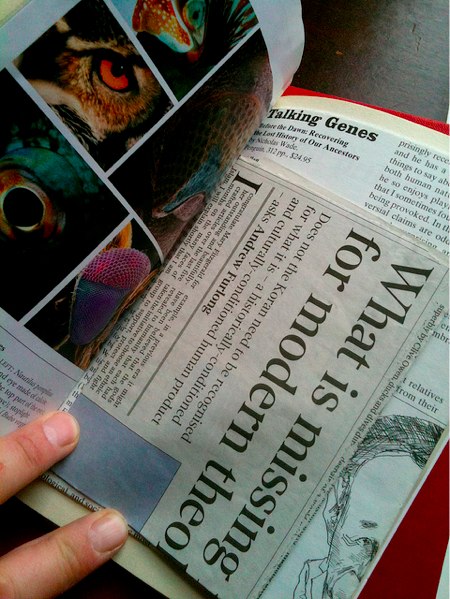
My dad was book mad. He owned a couple of thousand books, mostly non-fiction. He was an old-school, working class, self-taught polymath, a bus conductor-know-all (I’ve written about his dictionaries before). And he had this habit. He would snip cuttings from newspapers and magazines. Almost daily he’d snip a story of some import and file it away inside one of his many books.

And there was method in this compulsive snipping and filing. The cutting always went inside a book of some relevance to the story – cuttings about Kennedy and Nixon inside an American history, cuttings about captured Nazis inside a book about the war. An Alan Coren column in a Thurber collection. Some books were bulging – mum and I used to laugh as we pulled a book down from a shelf and a confetti of cuttings fell out.

But this carefully-assembled distributed scrapbook was pointless – an essentially write-only collection that was destined never to to be seen (the fact that the whole lot was destroyed in a flood at Christmas is just a melancholy full stop to the story). No one was ever going to read or reflect on these cuttings. And there’s an exact parallel with my dad’s manic clipping and saving in the universal curatorial reflex of the social networks. The three-stage process: see something interesting, read it and then – click – it’s shared. It’s a kind of twitch, already so natural that we’ve forgotten how we got started and when.

Sharing is now so part of the process that it influences the kind of content we absorb. I’d love the paywalls to work but I suspect they’ll fail because they short-circuit this curatorial reflex. I cancelled my Times subscription when I realised that being unable to share the marvellous stuff in there – Aaronovitch, Moran, Finkelstein – made it less valuable. I enjoyed it less because I couldn’t share it with my friends. The big publishers can’t ignore the curatorial habit – they’ll have to adjust their offerings to accommodate the twitch.

I clip and save obsessively too (is it a heritable trait?). Since we closed Speechification.com I’ve been posting things at Audiolibre.net and at /Reading. Audiolibre’s a bit like Speechification but I’m sticking to sound recordings that are free to republish. Public domain, creative commons, out-of-copyright stuff that’s explicitly shared by its owners (like the RTE programme that’s at the top now). And there’s plenty of this stuff out there too but it’s a bit of an adventure and I’m looking for new sources (send me your favourites).

And /Reading is a straight copy of James Bridle’s Mattins. He’s been reading bits of books he loves into his phone for a while now (although he’s evidently on a break right now). This is a twist on the trusted guide thing. I trust James to switch me onto writing I wouldn’t have met otherwise and the excerpt he reads makes the whole thing more vivid – and I can listen on the way to work. He’s been reading mainly fiction and poetry but I’m focused (like my old man) on non-fiction – and I’m trying to dig up stuff you won’t find on the non-fiction table at Waterstones. Like this out-of-print anthology of writing about the industrial revolution collected by Mass Observation founder Humphrey Jennings.

/Reading is more of an experiment – should I publish my reading with no commentary or should I add a short review or some context? Will people find my selections useful or are they just bleeding chunks too short to inform a decision? Is this legitimate recommendation or self-indulgence? Will publishers be OK with these short readings? /Reading uses Audioboo because it’s just so accessible (and because it’s easy to lift and embed the audio). For Audiolibre I’ve used an HTML 5 player which means it’ll work on an iPhone or an iPad. Both are available as podcasts and that seems like the right way to package this stuff.

I’ll keep collecting and sharing (because I can’t help it) and I’ll see what happens – tell me what you think and suggest new audio sources and books too.